Insights

Engineering notes from the Tech Programmer team

Practical guidance on AI integration, cloud migration, DevOps, and custom software — written by the engineers who ship it.

Web & App Development (8)Cloud & DevOps (8)AI Integration (5)Custom Software Development (4)
gRPC vs REST — API style decision guide banner
Web & App Development

gRPC vs REST: Which API Style Should You Use?

REST exposes resources over HTTP with JSON — the default for browsers, public APIs, and third-party clients. gRPC is a remote-procedure-call system that uses Protocol Buffers and HTTP/2, with generated clients and built-in streaming. Prefer REST at the edge. Prefer gRPC for internal service-to-service calls when you own both sides and need a strict contract or streaming. Most products that need both keep REST outside and gRPC inside.

8 min readRead
Kafka vs RabbitMQ — messaging decision guide banner
Cloud & DevOps

Kafka vs RabbitMQ: Which Messaging System Should You Use?

RabbitMQ is a message broker built around queues, exchanges, and per-message acknowledgement — ideal for background jobs, RPC, and complex routing. Apache Kafka is an event streaming platform: durable partitioned logs that many consumer groups can read independently and replay. Prefer RabbitMQ when messages are work items processed once. Prefer Kafka when events retain value after reading. Mature systems often run both.

8 min readRead
JWT vs session authentication — decision guide banner
Web & App Development

JWT vs Session Authentication: Which Should Your App Use?

Server-side sessions store a session ID in an HttpOnly cookie and look it up on every request — logout and bans take effect immediately. JWTs are signed, self-contained tokens the client sends back; the server verifies the signature without a session store. Prefer sessions for first-party browser apps. Prefer short-lived JWTs (plus server-stored refresh tokens) for mobile clients, public APIs, and microservices that cannot share a session store. Many products use both.

8 min readRead
GitHub Actions vs GitLab CI vs Jenkins — CI/CD comparison banner
Cloud & DevOps

GitHub Actions vs GitLab CI vs Jenkins: Which CI/CD Tool Should You Use?

GitHub Actions is the default when your repositories already live on GitHub — triggers, secrets, and pull-request workflows are native. GitLab CI makes sense when you want source control, pipelines, registry, and security scanning in one platform. Jenkins remains relevant when you need air-gapped hosting, bespoke hardware agents, or deep legacy plugin integrations — at the cost of running the controller yourself.

8 min readRead
Webhooks vs polling — API integration decision guide banner
Web & App Development

Webhooks vs Polling: Which Integration Pattern Should You Use?

Webhooks push event data to your server when something happens; polling asks an API on a schedule whether anything changed. Prefer webhooks for near-real-time reaction when you can expose a public HTTPS endpoint. Prefer polling when delay is acceptable, the provider has no webhooks, or you cannot accept inbound traffic. For payments and other high-stakes sync, use both: webhooks for speed and a reconciliation poll for correctness.

7 min readRead
LLM evaluation guide — golden sets, judges, and CI gates banner
AI Integration

LLM Evaluation: How to Test AI Features Before (and After) They Ship

LLM evaluation measures whether your AI application behaves as intended on realistic inputs — correctness, faithfulness, safety, and task success — not whether the text sounds fluent. Start with traces and a small golden set, combine deterministic checks with calibrated LLM-as-a-judge, gate prompt and model changes in CI, and keep production failures feeding the next regression suite.

8 min readRead
Feature flags vs feature branches — release control decision guide banner
Cloud & DevOps

Feature Flags vs Feature Branches: How to Release Without Long-Lived Pain

Feature branches isolate unfinished work in Git before merge. Feature flags control who sees that work after it is deployed. They are not rivals — short-lived branches plus runtime flags let you merge often, separate deploy from release, and kill a bad rollout without a full revert.

7 min readRead
PostgreSQL vs MongoDB for SaaS — database decision guide banner
Web & App Development

PostgreSQL vs MongoDB for SaaS: Which Database Should You Choose?

For most SaaS products, PostgreSQL is the safer default — relational integrity, SQL reporting, JSONB for flexible fields, and Row-Level Security for multi-tenant isolation. MongoDB earns the call when your core data is genuinely document-shaped, schema-flexible, or needs native horizontal sharding for high write throughput.

8 min readRead
Multi-tenant vs single-tenant SaaS architecture — decision guide banner
Custom Software Development

Multi-Tenant vs Single-Tenant SaaS: Which Architecture Should You Build?

Multi-tenant architecture shares one application across customers with logical data isolation; single-tenant gives each customer a dedicated environment. Most SaaS products should start pooled (multi-tenant) and add dedicated silos only when compliance, noisy neighbors, or enterprise contracts demand it.

8 min readRead
REST vs GraphQL — which API style to choose in 2026 banner
Web & App Development

REST vs. GraphQL: Which Should Your API Use in 2026?

REST and GraphQL are not interchangeable upgrades — they solve different client problems. REST is still the right default for public APIs, webhooks, and most MVPs; GraphQL earns its complexity when several clients need different slices of a deeply connected data graph.

7 min readRead
When Should a Startup Use Kubernetes? — 2026 decision guide banner
Cloud & DevOps

When Should a Startup Use Kubernetes? (And When It's Too Early)

Kubernetes dominates industry surveys, but most early-stage teams should not run a cluster on day one. Here is the progression that actually works — Compose, managed containers, then Kubernetes — and the operational signals that mean you are ready.

7 min readRead
AI Agent Security in 2026 — risks and how to prevent them banner
AI Integration

AI Agent Security: The Real Risks in 2026, and How to Actually Manage Them

AI agents don't usually fail because someone broke in — they fail because they were talked into doing the wrong thing, or given more access than anyone meant to grant. Here is what the 2026 breach data actually shows, and the controls that catch it before it costs you data or trust.

8 min readRead
Serverless vs. Containers — which should you choose in 2026 banner
Cloud & DevOps

Serverless vs. Containers: Which Should You Choose in 2026?

Serverless and containers solve the same problem — running your code in the cloud — with opposite trade-offs: pay-per-use with zero idle cost vs. full runtime control with a fixed baseline. Here's how to actually decide, including the hybrid pattern most production systems land on.

7 min readRead
PWA vs. Native App — which should you build in 2026 banner
Web & App Development

PWA vs. Native App: Which Should You Build in 2026?

A progressive web app and a native app solve the same problem differently — one codebase you can ship instantly vs. two platform-specific builds with full device access. Here is how to actually decide, including the iOS limitation that changes the calculus for a lot of teams.

8 min readRead
ERP vs. CRM — what's the difference guide banner
Custom Software Development

ERP vs. CRM: What's the Difference, and Do You Need Both?

ERP and CRM aren't competing tools — they manage different halves of the business, and most companies that keep growing end up needing both. Here's how to decide which to start with, and where ERP-CRM integrations actually go wrong.

6 min readRead
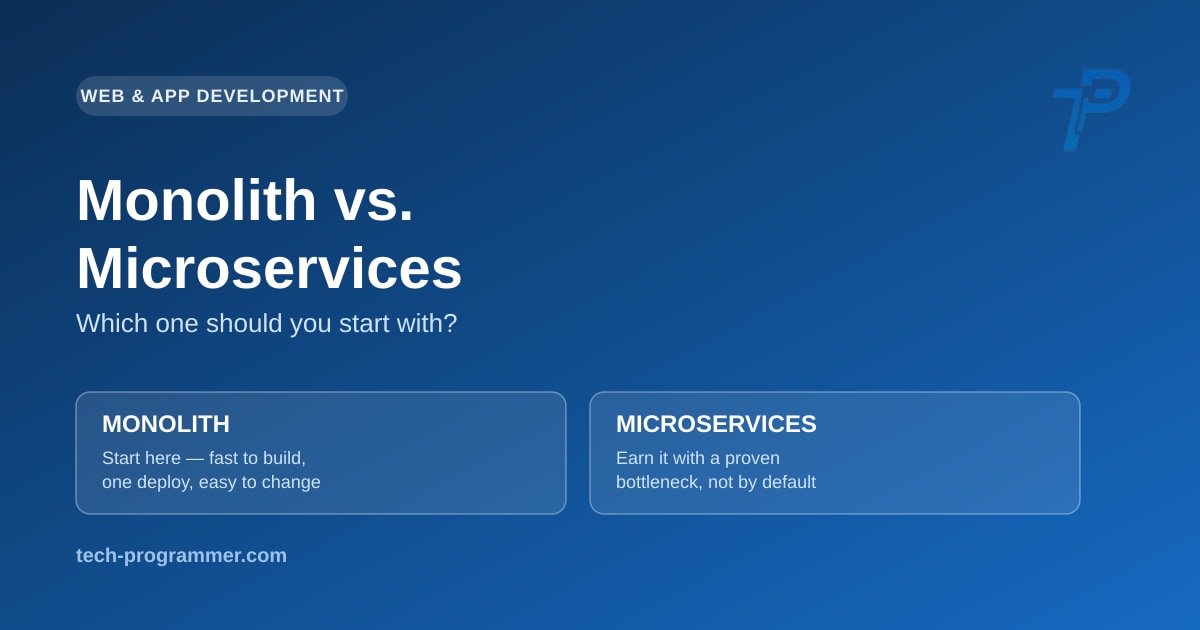
Monolith vs. Microservices — a decision framework for choosing the right architecture
Web & App Development

Monolith vs. Microservices: Which Should You Start With?

Choosing between a monolith and microservices isn't a permanent identity — it's a sequencing question. Here is a framework for deciding which one you need now, and a real case where going back to a monolith cut infrastructure cost by 90%.

8 min readRead